Best smart thermostats with full local control
Z-Wave, Zigbee and Matter/Thread thermostats that keep heat working without the cloud, plus how ecobee Premium and the Honeywell T9 compare in Home Assistant.
On this page
The thermostat is the last place I’d accept a cloud dependency. A cloud-only thermostat can lose remote control - or worse, scheduling - when your internet drops. The thermostats below talk to Home Assistant over a local protocol (Z-Wave, Zigbee, or Matter over Thread), so core heating and cooling keep working regardless of the internet.
Already on Z-Wave with a standard 24V system, buy the Honeywell T6 Pro Z-Wave. Electric baseboard or other line-voltage heat, Sinopé’s Zigbee models. Hydronic radiators, the Eve Thermo over Thread with a border router. Mini-split with IR only, a self-flashed ESPHome blaster rather than a cloud controller. Match the thermostat to your heating system and to a protocol you already run, and all of these keep working when your internet doesn’t. I haven’t run any of these thermostats in my own house; the picks rest on the spec sheets, the integration docs, and reports from the Home Assistant forums.
What “locally controllable” really means
It means the device exposes a local interface - Z-Wave, Zigbee, or Matter - that Home Assistant talks to directly, on your network, without routing through the manufacturer’s servers. A lot of Wi-Fi thermostats marketed as “smart home compatible” only offer a cloud API; those don’t count for this list, no matter how good the app is.
This is exactly where a couple of popular names trip people up. Ecobee has no local API - its Home Assistant integration is cloud-based (and even after the 2026 change that dropped the developer-key requirement, it still goes through Ecobee’s servers). Some Ecobee models can be controlled locally over HomeKit Controller if your network supports mDNS, but that’s a workaround, not a documented local API. Mysa has no native local API either, and its own Home Assistant path runs through the Mysa cloud API. Mysa’s five Wi-Fi models (Baseboard, Baseboard V2, Baseboard LITE, Mini-Split and In-Floor) are HomeKit accessories, so the same HomeKit Controller workaround applies to them and does give local LAN control, though you have to pair through the Mysa app’s “Mysa Pairing” option, and once Home Assistant claims the accessory you lose the Apple Home pairing. The newest model is the exception worth knowing about: the Mysa Smart Thermostat for Central HVAC is Matter certified, so it joins Home Assistant over the native Matter integration with real local control and no workaround at all. Mysa’s support documentation scopes that narrowly: Matter is available on the Central HVAC model only. Don’t buy either expecting a documented local API.
Top picks for local control
Honeywell/Resideo T6 Pro Z-Wave
The T6 Pro Z-Wave is the dependable choice if you already run a Z-Wave network. It pairs to your Z-Wave coordinator and integrates cleanly with Home Assistant with no cloud dependency at all - setpoints, mode and current temperature all local. The display and on-device UI are utilitarian, but it’s reliable and well-supported. For most low-voltage (24V) heating/cooling systems in North America, this is the safe default. Buy the Z-Wave variant deliberately: the current SKU is the TH6320ZW2007, and the older TH6320ZW2003 is the same hardware but has been discontinued. The near-identically named -WF model is the Wi-Fi and cloud version, not a Z-Wave one.
Sinopé thermostats (Zigbee or Wi-Fi)
Sinopé is the go-to for North American electric heating - line-voltage baseboards, convectors, and low-voltage systems - which most thermostats handle poorly. Choose the Zigbee models for local control - the line-voltage Sinopé TH1123ZB is the baseboard pick. They pair straight through ZHA or Zigbee2MQTT with no Sinopé hub in the middle and run entirely on your network; the GT130 gateway and the Neviweb cloud are only needed for Sinopé’s own app, not for Home Assistant. Sinopé also sells Wi-Fi models that talk to Neviweb directly, so stick to the Zigbee line if local-first is the goal. If you heat with electric baseboards and want true local control, this is the strongest option here.
Eve Thermo (Matter over Thread)
The Eve Thermo is a radiator valve (TRV), not a wall thermostat - relevant if you have European-style hydronic radiators. The current Matter generation runs over Thread, stores its schedule on the device, and keeps heating routines and manual control working during an internet outage. You need a Thread border router (a HomePod mini, the built-in radio on a Home Assistant Yellow if you already own one, or another border router) and it joins Home Assistant via the Matter integration. Note that Yellow’s single Silicon Labs radio runs Zigbee or Thread, not both at once, so pressing it into service as your border router means adding a separate Zigbee coordinator. Matter support in HA is solid now but occasionally needs a re-pair; hardware quality is good.
A note on whole-house IR / mini-splits
If you have a ductless mini-split with only an IR remote, there isn’t a great fully-local thermostat answer. IR-blaster controllers (Sensibo, Tado, and similar) generally run their smart features through the vendor cloud. The fully local route is an ESPHome-based IR blaster (e.g. a board with the right IR climate component for your unit) flashed yourself - more effort, but fully local. Treat the commercial IR controllers as cloud devices.
Aqara Thermostat Hub W200
The W200 is the unusual one: a Matter 1.4 thermostat that is also a Thread border router and a mesh extender, so it can stand in for a border router you were otherwise going to buy. Home Assistant picks it up over the native Matter integration, which makes setpoints, mode and current temperature local. It carries a built-in Zigbee hub as well, but that side only accepts Aqara’s own Zigbee devices - it is a vendor bridge, not a replacement for ZHA or Zigbee2MQTT. Aqara puts compatibility at about 85% of HVAC systems; line-voltage, millivolt and 0-10VDC systems are excluded, so this is a low-voltage central HVAC pick only.
What to avoid for local-first builds
- Ecobee - cloud integration, no local API (HomeKit Controller is the only local-ish path, and only on supported models).
- Mysa - no local API on the Wi-Fi models; cloud by default, with the same HomeKit Controller workaround as Ecobee. The exception is the Matter-certified Mysa Smart Thermostat for Central HVAC, which does have real local control.
- Most Nest models - core functions still lean on Google’s servers.
- Sensibo and similar IR blasters - cloud APIs; your control stops when the internet does.
- tado V3+ - cloud by default, and tado has moved its cloud API to a daily call quota that varies by subscription tier, which caught out Home Assistant users who polled it often. It is not a dead end for local control, though: tado’s own guidance points V3 and V3+ owners at HomeKit via the Internet Bridge V3+ as the local route, and Home Assistant reaches it through the HomeKit Controller integration, so temperature reads and setpoint writes stay on your LAN and don’t count against the quota. Going further is tado’s newer X line: the tado Smart Thermostat X runs Matter over Thread and keeps working locally without the tado cloud, though it is sold only in Europe and the UK. tado lists 28 supported countries (the EU, the UK and Switzerland); the US is not among them. The X devices also need a Thread border router, either tado’s own Bridge X or a third-party one.
The popular cloud thermostats: ecobee Premium and Honeywell Home T9
If you are weighing the mainstream cloud thermostats instead, this is how the two behave. Neither is a local-purist product, and neither belongs in the picks above. But if you want a thermostat that still makes sense in a practical, local-first house, the ecobee Premium is the stronger recommendation, because it has broader ecosystem usefulness, better Home Assistant fit, and less dead-end energy than the Honeywell Home T9. The T9 has been discontinued by Honeywell, so it is now remaining-stock and secondary-market only. It is still worth considering if your main problem is uneven rooms and you specifically want remote room sensors to influence comfort, but new buyers should also look at its successor, the Honeywell Home X8S, which is Matter certified and takes the same wireless room sensors. I haven’t run either of these; the comparison rests on the spec sheets and what I’ve read from people who own them.
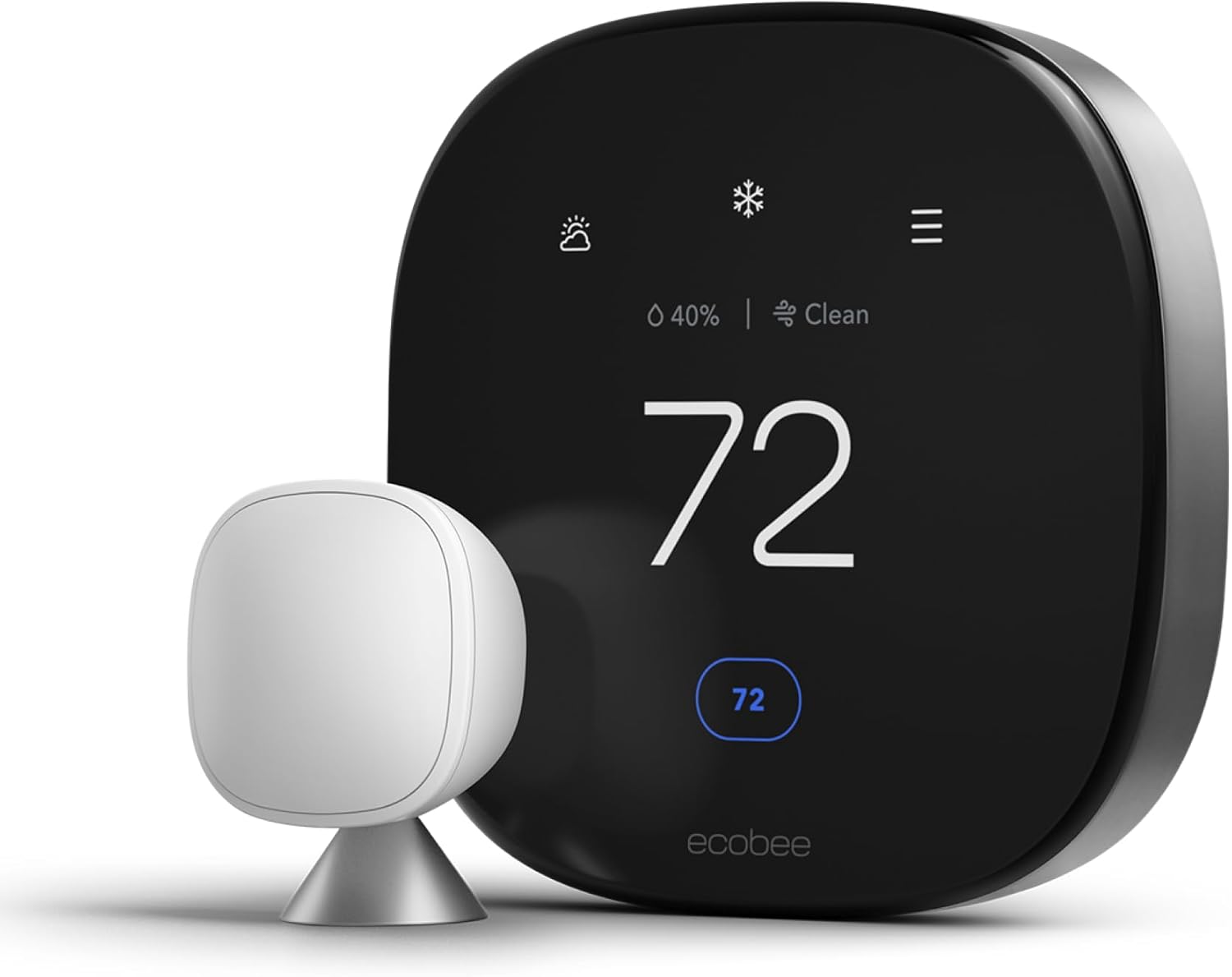
ecobee Premium
If you can tolerate some cloud dependence, the ecobee Premium is the one of the two that reads as the most broadly competent.
Why it wins:
- better overall ecosystem support than the T9
- a workable Home Assistant integration path, even though it runs through ecobee’s servers
- broad ecosystem reach (HomeKit, Alexa, Google, SmartThings, IFTTT) gives it a more future-proof posture than a lot of legacy Wi-Fi thermostats, though it does not support Matter
- the built-in air-quality monitoring is useful for some homes, rather than decorative spec-sheet glitter
Why I would still hesitate:
- it includes a microphone and Alexa, which is an immediate privacy no for some people
- the clever features still lean on cloud services more than local-first buyers would ideally want
- it’s expensive for something whose core job is still “manage HVAC sanely”
Honeywell Home T9 (discontinued)
The T9 earns its place because remote room sensors solve a real problem: one thermostat location often does a terrible job representing the rooms people use. One important caveat before you buy: Honeywell has discontinued the T9. Its own store lists the thermostat as discontinued and points buyers to the Honeywell Home X8S instead, and Resideo now sells the T9 through professional partners only. Existing T9 owners are fine, and remaining stock still works exactly as described here, but treat this as an end-of-life product rather than a fresh purchase.
What it offers:
- room-priority comfort is worth it in larger or awkward homes
- Google and Alexa support are solid enough for mainstream households
- setup is easy enough by thermostat standards
Why it isn’t the top recommendation:
- the Home Assistant story is cloud-based and less satisfying
- local control is limited
- it is discontinued, so you are buying remaining stock rather than a supported current model
- it works with Apple Home (HomeKit) but has no Matter support, which limits long-term flexibility
How the two behave in Home Assistant and offline
In Home Assistant the ecobee Premium is the better fit, even though it still isn’t fully local in the way many Zigbee devices are. The T9 works, but the cloud dependency is harder to ignore if Home Assistant is your center of gravity; if you want the most fully local path, look at Z-Wave thermostats for Home Assistant instead, since a Z-Wave thermostat keeps its schedule and control on your own hub. If broader ecosystem compatibility matters, ecobee is again the easier answer. If your house is mostly Google Assistant or Alexa and you mainly care about room balancing, the T9 is still defensible.
Both units keep basic thermostat behavior alive offline, which matters. But the smarter layers on both products are still meaningfully cloud-shaped, and ecobee’s built-in voice hardware adds extra privacy baggage. For a sense of what keeps running when the connection drops, see devices that work when the internet dies.
Be suspicious of thermostats that sound “smart” mainly because they have voice assistants built in, aggressively cloud-centric scheduling logic, or lots of ecosystem badges but weak local integration in practice. A thermostat should first be dependable boring infrastructure. If the smart layer makes that worse, it isn’t worth paying for.