Best local in-wall relays for Home Assistant
The best hidden relay modules for local-first smart homes, especially when you want to keep existing switches and still get strong Home Assistant control.
On this page
In-wall relays are the part of the smart home market that feels the most like contraband competence.
They don’t photograph well. They aren’t beginner-friendly. But they can be a better answer than replacing every wall switch in the house with expensive branded hardware.
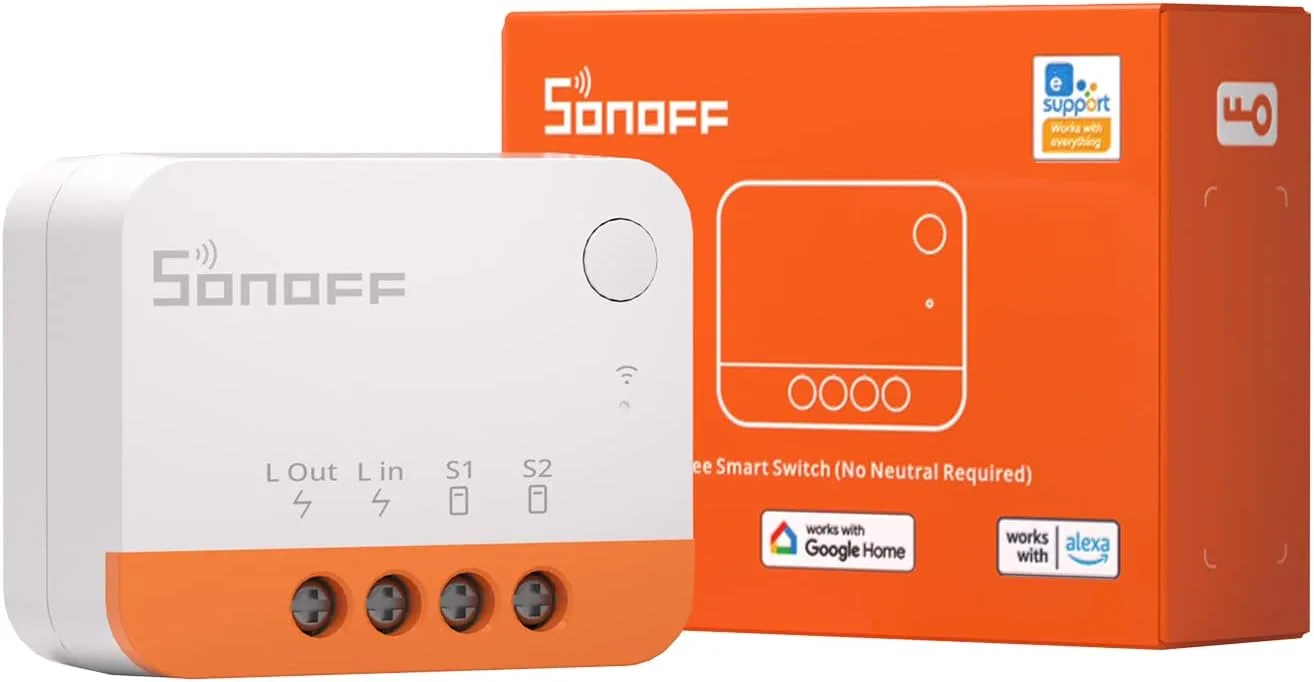
Two picks hold up: the Shelly 1 Gen4 as the Wi-Fi relay for flexible local control, and the SONOFF ZBMINI-L2 as the Zigbee relay for older homes without neutral wires.
Quick verdict
If you’re comfortable with wiring and want the most flexible local-control option, buy the Shelly 1 Gen4, Shelly’s current-generation in-wall relay. It puts Wi-Fi, Zigbee and Matter on the table, one at a time.
If your home has no neutral at the switch box, the SONOFF ZBMINI-L2 is the easier recommendation because that one detail decides a lot of real installs.
How I judge relays
There’s more to a relay than whether it switches power on and off.
I care about:
- How strong the local control story is
- Whether the install is realistic for older homes
- How well the relay fits Home Assistant
- Whether the product adds Wi-Fi clutter or strengthens an existing Zigbee mesh
- Whether it’s a sane way to preserve normal wall-switch behavior
Best flexible local-first pick: Shelly 1 Gen4
Shelly 1 Gen4 is the stronger general recommendation when the wiring situation allows it. It is the current generation of the relay this section used to lead with, the Shelly Plus 1, which Shelly has now discontinued.
Why it stands out:
- excellent local APIs and MQTT support
- great Home Assistant fit
- tiny size makes it practical behind existing wall controls and in junction boxes
- affordable enough that it scales beyond a single “test” install
I haven’t run the 1 Gen4 itself. I do run the Plus 1 it replaces, now discontinued, and gave it 4.5/5 in my owner review: very reliable and easy to install, though a little harder to fit inside the electrical box, and if I’m only controlling lights I prefer the Mini. The Gen4 pick rests on that same local Shelly integration plus what other owners say about it.
One generation note before you buy: the Shelly Plus 1 is Shelly’s Gen2 part, and Shelly has discontinued it. It still works, and it still gets the same excellent local Home Assistant integration, so it stays fine if you already own one - but the Gen4 is the one to buy new. The Gen4 runs one radio profile at a time, and in Zigbee mode it repeats the mesh instead of sitting on it as an end device. Bluetooth is there for setup either way, but the unit ships in the Matter-over-Wi-Fi profile, and a five-press on the device button switches it to Zigbee 3.0 - so it is Wi-Fi or Zigbee, never both at once. Like the Plus 1, it needs a neutral at the switch box.
Why I would hesitate:
- it’s still an advanced install, not a casual one
- in its default Wi-Fi profile it is one more device on your wireless network, which adds up if you use them everywhere
Best old-house relay: SONOFF ZBMINI-L2
The SONOFF ZBMINI-L2 matters because a lot of older homes don’t have a neutral wire where the switch lives.
That turns many otherwise-good relay ideas into dead ends.
Why this one earns a place:
- no-neutral support is a real practical advantage
- fully local Zigbee behavior
- small enough to hide inside existing wall boxes
Its main tradeoff is obvious: you need a Zigbee coordinator, and the install is still not for people who shouldn’t be touching mains wiring. One more thing worth knowing: because the L2 runs without a neutral, it behaves as a Zigbee end device rather than a mains-powered router, so it won’t extend your mesh the way some neutral-wired relays do.
Wi-Fi vs Zigbee for relays
This is one of the places where protocol choice matters.
If you have a neutral at the box, Shelly’s Gen4 relays now let you make that call at install time rather than at purchase time: the same part can join as a Matter-over-Wi-Fi device or as a Zigbee one, though only ever one of them at a time. Where there is no neutral, the wiring still makes the choice for you.
Choose the Shelly 1 Gen4 if you want:
- flexible local APIs
- strong MQTT workflows
- no extra coordinator requirement
Choose SONOFF ZBMINI-L2 if you want:
- no-neutral compatibility
- fewer Wi-Fi devices
- a fully local Zigbee switch for no-neutral boxes
Both of those picks come out of the same head-to-head: Shelly vs Sonoff for relays works through the neutral wire, the load ratings and which SKUs actually meter power, and it is the page to read if the two lists above did not settle it. If the answer there sends you toward a Sonoff, when Shelly beats Tasmota and when it does not is the follow-up on whether you need to flash it at all.
The Z-Wave option most people miss
The Wi-Fi-versus-Zigbee framing above skips a third choice. Shelly also makes a Z-Wave relay line, which matters if your house already runs a Z-Wave mesh and you would rather not add a second radio for the sake of one circuit.
The Shelly Wave 1PM is the single-channel version, with power metering on the circuit and Z-Wave Long Range support for better reach back to the controller. It runs fully local through Z-Wave JS and hides behind an existing switch the same way the Plus 1 does. I run one, and it’s the Shelly I rated highest (5/5) in my owner review.
If you would rather wire at the panel than behind every switch, the Shelly Wave Pro 1PM is the DIN-rail version of the same idea: same Z-Wave JS integration, same power monitoring, mounted on a rail instead of stuffed into a wall box. The install is more work, but the result is tidier and much easier to service later.
When you want the input, not the relay
Sometimes the job is not switching a load at all. You want an existing dumb wall switch to fire Home Assistant scenes while the light it controls stays on exactly the circuit it always had.
The Shelly Plus i4 is built for that and nothing else. It has four dry-contact inputs and no relay, detects single, double and long presses, and sends those events to Home Assistant over the local Shelly integration or straight to an MQTT broker. Wire it behind switches you do not want to replace and you get scene control without changing anything the rest of the household can see.
What to avoid
Avoid in-wall products if:
- you’re not comfortable with mains wiring
- you can’t verify the wiring situation first
- you really just want an easier smart switch replacement
A relay is often the best tool only when you specifically want to keep the existing switch hardware or solve an awkward electrical case. If you just want a nicer switch, the best local smart switches and dimmers is the page for that. And if the specific thing you want is a replacement switch whose paddle still works with the network down, smart switches that keep the physical button is the narrower cut of that list.
And if the goal is one screen on the wall rather than better switches, PoE touch panels for wall controls covers that route, including which panels really run on PoE and which only claim to.